
C-01 — Program
Cyber Security Internship
Linux, networking, ethical hacking and VAPT in one guided, hands-on internship — your own lab, real tools and mentorship, finishing with a complete VAPT report and a project under your name.
₹7,9994-month internship + 1-month project
100% hands-on labsReal industry toolsLive mentorshipCompletion certificate
Register your seat
Takes a minute. We'll reach out about the batch, a free demo and fees.
4 months
Internship — hands-on training
- Linux & networking foundations
- Ethical hacking & web app security
- Vulnerability assessment & VAPT
- Bonus: AI & LLM security
1 month
Project
- A full end-to-end VAPT assessment
- A professional report under your name
- Portfolio + interview preparation
What you'll earn
Your certificate of completion.
Finish the program and receive a verified Cybilution certificate in your name — unlocked on completion.
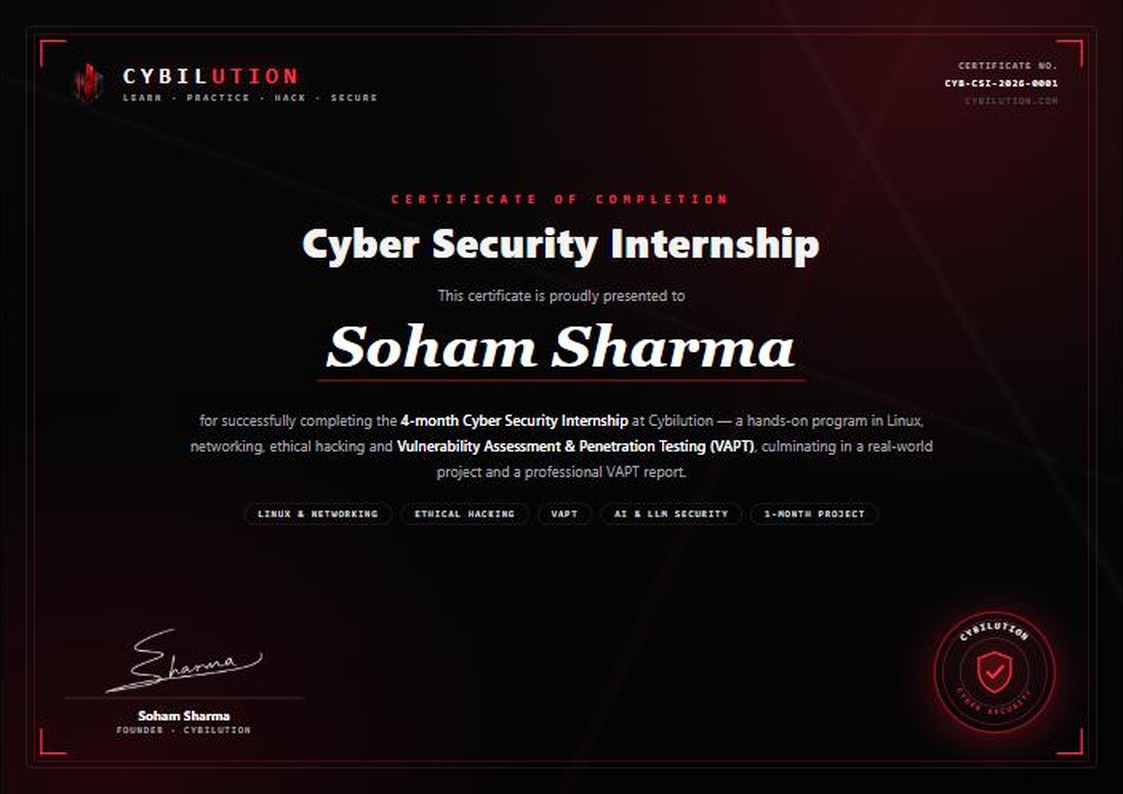
Locked
This certificate could carry your name.
Finish the Cyber Security Internship to earn your own verified Certificate of Completion, issued in your name.
Start the internshipFull syllabus
Everything you'll learn.
Nine modules, beginner to job-ready — Linux and networking foundations, full ethical hacking & VAPT, a bonus AI & LLM security module, and complete career prep. Tap any module to expand it.
- What security really means — the CIA triad
- Types of hackers and the phases of a hack
- Career paths in cyber security
- The basics of defence
- SA1 — Foundations: installation, basic commands, man/info, directory structure
- SA1 — Text editors (Vim, Vi, Nano), hardware commands, archives & compression
- SA1 — Users & access: users, groups, permissions, ACLs, password policy, sudo
- SA1 — Processes & services: start, stop and manage services
- SA1 — Networking & remote access: network config, hostname, SSH, SCP
- SA1 — Admin tasks: scheduling with crontab, installing & updating packages
- SA1 — Recovery & virtualization: reset a lost root password, build your labs
- SA2 — Text processing: regular expressions for searching and analysing logs
- SA2 — Storage & disks: partitioning, swap and LVM
- SA2 — File sharing with NFS
- SA2 — Security & performance: the Linux firewall, nice & renice
- Network devices: hub, switch, Layer-3 switch, router, access points
- Design & architecture: topologies, P2P vs client-server, VLANs, DMZ, segregation
- Models & addressing: OSI & TCP/IP, encapsulation, IPv4, public vs private IP, NAT, subnetting
- Core protocols: TCP, UDP, IP, ICMP, ARP, DNS, DHCP, HTTP/S, FTP, SSH, Telnet, RDP, SMTP, SNMP, handshakes
- Network security: firewalls, access control, proxy, load balancer, VPN, SSL/TLS, NAC, IDS/IPS, sandboxing
- Enterprise basics: MPLS overview, web-server/IIS basics, corporate network layout
- Basic CCNA: VLANs, trunking, inter-VLAN routing, STP, port security
- Basic CCNA: static & default routes, intro to RIP/OSPF, DHCP, NAT/PAT, ACLs, troubleshooting
- Packet analysis with Wireshark (capture & display filters)
- Hashing; symmetric vs asymmetric encryption
- Host-based intrusion detection (OSSEC) and file-integrity monitoring
- Malware checks with VirusTotal
- How websites work — HTTP/HTTPS, sessions & cookies
- The OWASP Top 10, hands-on
- Burp Suite (Proxy, Repeater, Intruder) and Gobuster
- Practice labs: OWASP Juice Shop and PortSwigger
- Bug-bounty methodology: subdomain enumeration; auth, JWT & OAuth flaws; IDOR & access control
- Injection (SQL, command, SSTI, XXE); XSS, CSRF, CORS; SSRF, file upload & business-logic abuse; cloud misconfiguration
- Footprinting & OSINT: passive vs active recon, Google dorking, WHOIS/DNS, email & website intel
- Scanning & enumeration: host discovery, port scanning, OS/service detection with Nmap and the Nmap Scripting Engine
- Password-attack concepts and tools such as Hydra — practised only on lab machines
- Social engineering & malware: phishing & impersonation, phishing simulations, malware classification
- Core pentest skills: privilege escalation (Linux & Windows), buffer-overflow concepts, public exploits, tunnelling & Metasploit
- CVE identifiers, CVSS scoring and the NVD
- Automated vs manual scanning with Nikto & Nessus on a vulnerable lab target
- Scope & authorisation and a structured penetration-testing methodology
- Tying recon, scanning, enumeration and exploitation into one full assessment
- Capstone: an end-to-end assessment on a vulnerable network and web app, written up as a complete VAPT report
- AI foundations: how LLMs work, tokens & context, RAG, AI agents & tool use, and the attack surface
- OWASP Top 10 for LLM apps: prompt injection (direct & indirect), sensitive-data disclosure, insecure output handling, excessive agency, supply-chain & poisoning
- AI red teaming: scoping, test cases, jailbreak & guardrail testing, documenting results safely
- Securing AI-powered apps: API & auth security, input/output filtering, least-privilege tool access, logging & monitoring
- Adversarial ML concepts: evasion, data poisoning, model extraction and privacy attacks
- Labs: attack then defend a vulnerable chatbot, test a RAG app for leakage, review an AI agent's permissions
- Report writing: executive summary, technical findings, severity scoring and remediation
- Career guidance: job-search strategy and common interview question patterns
- Resume & LinkedIn building, plus communication and presentation skills
- A mock technical interview to get you ready for the real thing
- Free 1-month internship — shape a real project, with a separate Internship Completion Certificate